
Snapped Torsion Springs
Snapped torsion springs on double doors lead the list, mostly on houses from the 1967-1985 run where the original spring has simply worn out after decades of cycles.
Chula Vista, CA
Garage door repair for Chula Vista homes built mostly between 1967 and 1985. Springs, openers, and panels fixed by people who know this housing stock.

Garage door services
From emergency repair and spring work to opener repair, panel replacement, maintenance, and new door installation, the lineup is built around Chula Vista's 1967-1985 housing stock and the original torsion and extension hardware still common across the area.


Common Chula Vista garage door problems
Snapped torsion springs on double doors lead the list, mostly on houses from that 1967-1985 run where the original spring has simply worn out after decades of cycles. Right behind that are openers that grind and cables that fray. One thing worth saying plainly: our mild temperate climate means we're not chasing freeze-cracked seals or ice-jammed tracks the way a colder-climate company would, so that's one failure mode we rarely see here, and you shouldn't pay for a fix aimed at a problem this climate doesn't cause.
Snapped torsion springs on double doors lead the list, mostly on houses from the 1967-1985 run where the original spring has simply worn out after decades of cycles.
Openers that are grinding, chain-driven units from an earlier retrofit era that finally give up on the gear, come up right behind spring failures.
Cables fraying at the bottom bracket show up often enough on older single-car garages that we carry stock cable on the truck rather than order it.
Rollers are a smaller job but a common one - nylon rollers that have gone from quiet to clattering, usually tied to the same age bracket.
What we do see more of is UV and heat wear on weatherstripping and on plastic idler pulleys after years in the sun, which is a smaller, cheaper fix than most people expect.
Clear repair guidance
We're not going to print a price list here, because a spring job on a 16-foot double door isn't the same job as a 9-foot single, and what's wrong with your opener isn't always what it looks like from the kitchen. What we can tell you is what drives the number: the weight and width of the door, whether the springs are torsion or extension, how old the opener is, and whether a part has to be ordered instead of pulled off the truck.
Median household income across our service area runs around $100,052, which tells you this isn't a market where people are shopping for the cheapest possible patch - most owners want it done right once, not fixed twice in a year. We quote the job after we've looked at it, not before, because a phone estimate on a torsion spring job is a guess dressed up as a number.
One honest limit: if your door is original to a house built in the 70s and the track or jamb has warped, sometimes replacement makes more sense than another repair. We'll say so instead of billing you for a patch that won't hold.
Local housing matters

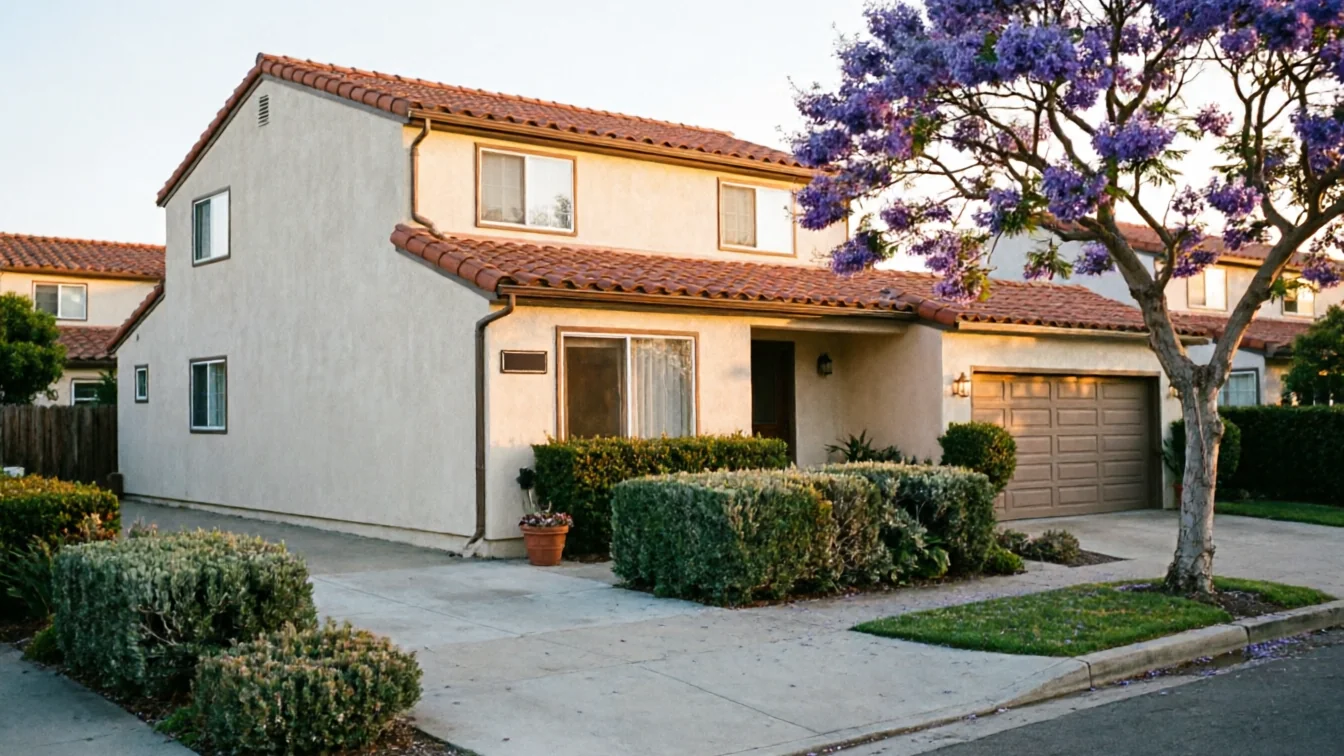
Across the 17 areas we cover - from Bonita and National City to Eastlake Greens and Rolling Hills Ranch - the pattern repeats: 1960s and 70s construction, single-car and two-car attached garages, steel sectional doors that were standard for the era. The build window runs 1967 to 1985, with the median landing at 1975. That's not a coincidence; it's when this part of the county built out fastest.
What that means for a door: torsion hardware from that period wasn't always the center-mounted style common now, and some houses still run side-mounted setups that newer parts don't bolt onto cleanly. Rollers worn to the shoulder, cables frayed at the drum, openers installed in the 80s or 90s as a second-generation retrofit - we see all of it because the base housing age hasn't changed even as owners have swapped in newer openers over the decades.
If your house sits in one of the newer pockets - Sunbow or San Miguel Ranch, for example - the door is younger too, and the failures run more toward electronics than steel. Either way, the fix depends on what decade your garage actually came from, not a generic age range.
1960s-1980s garage door systems
Because the base housing age hasn't moved, a single block can mix original side-mounted torsion hardware, worn steel-era rollers and cables, and openers retrofitted a generation or two ago - so what's on the door depends on what decade your garage actually came from.
Torsion hardware from the 1967-1985 era wasn't always the center-mounted style common now; some houses still run side-mounted setups that newer parts don't bolt onto cleanly.
Rollers worn to the shoulder and cables frayed at the drum are routine on original hardware that has cycled for decades.
Openers installed in the 80s or 90s as a second-generation retrofit are common, since owners have swapped in newer units even as the base housing age stayed the same.
In newer pockets like Sunbow or San Miguel Ranch the door is younger, and failures run more toward electronics than steel.
What to expect
You call and talk to a person who asks what the door is doing, not a script; we ask where you are because the neighborhood changes what we expect to find, and we quote the job after we've looked at it rather than guessing over the phone.
You talk to someone who asks what the door is doing, not a script. If it's a spring snapped on a double door or an opener that clicks but won't lift, we want to know the symptom before we quote anything.
We ask where you are because it changes what we expect to find. A house near Bonita Long Canyon built in the late 70s has different track geometry than a place out toward Otay Mesa West, so knowing the neighborhood means we're not guessing at parts twice.
We quote the job after we've looked at it, not before, because a phone estimate on a torsion spring job is a guess dressed up as a number.
We don't promise a same-day fix on every call. If the part isn't common it may take an extra day to get it to the truck, and we'd rather tell you that up front than promise something we can't back up on-site.
Uncommon Parts May Need Ordering
If the part isn't common - some older side-mounted setups take longer to source than current center-mounted systems - it may take an extra day to get it to the truck, and we'll tell you that up front.
Towns we serve
From our Chula Vista, CA base we run trucks across the surrounding towns rather than keeping a storefront in each one. These are the areas we serve most often - pick yours to see the local detail. We run service calls through Chula Vista and the surrounding communities: Bonita (3 mi), National City (6 mi), La Presa (6 mi), Imperial Beach (7 mi), Lemon Grove (7 mi), Coronado (8 mi), Casa de Oro-Mount Helix (10 mi), La Mesa (10 mi), Jamul (10 mi), Rancho San Diego (11 mi), Granite Hills (14 mi), Bostonia (14 mi), Crest (15 mi), Winter Gardens (15 mi), Lakeside (17 mi), Harbison Canyon (17 mi), and Eucalyptus Hills (18 mi).
Closer in, we're regularly out in Sunbow, Rancho del Rey, Bonita Long Canyon, San Miguel Ranch, Eastlake Business Center, Eastlake Greens, Ocean View Hills, Bay Terraces, Paradise Hills, Rolling Hills Ranch, Otay Mesa West, Palm City, Otay Mesa, San Ysidro, and Alta Vista - all within about five miles. That's across 127,255 households in the broader service area, with roughly 43,965 of those owner-occupied, which is the bulk of who calls us.
If you're outside this list, call anyway and ask - distance isn't always the deciding factor, timing sometimes is.
Questions
Yes, regularly. A lot of houses in our service area were built between 1967 and 1985, so original steel sectional doors and the torsion or extension hardware that came with them are common calls. Parts availability depends on the specific hardware - some older side-mounted setups take longer to source than current center-mounted systems.
Because door weight, spring type, and opener condition all change the job. A 16-foot double door on torsion springs is a different repair than a single door on extension springs. We look at the door before quoting rather than give a number over the phone, since a wrong guess helps nobody.
Yes. We run calls out to Bonita, National City, La Presa, Imperial Beach, Lemon Grove, Coronado, and several communities further out, plus the closer-in neighborhoods like Eastlake, Rolling Hills Ranch, and Otay Mesa. If you're not sure you're in range, call and ask.
Less than in colder climates. Our mild temperate conditions mean we don't see the freeze-cracked seals or ice-jammed tracks that are common complaints elsewhere. What we do see is sun and heat wear on weatherstripping and plastic rollers over time, which is usually a smaller repair.
Ready when you are
Chula Vista Garage Door Pros repairs and installs garage doors, springs and openers in Chula Vista, CA and the surrounding area.